Seven things to check before you buy a used game
Buying a used game is not a big deal, until it is. The case arrives, the disc has a scratch running right across the data side, and the listing said nothing more than “good condition”. Or the cartridge starts, but the save file is gone the moment you switch off, because the battery inside has been flat for years.
This does not happen because used games are bad. It happens because “used” means something different to everybody. Anyone who knows what to look at can buy for years without a single disappointment. Here is what we look at before a game is allowed onto our shelf.
First, what is actually in the box
The biggest price difference on used games does not come from the state of the disc, it comes from what is inside the case. A game sold as a bare disc or a bare cartridge is a completely different thing from one with case, cover art and manual. In the trade the second is often called CIB, complete in box.
So in a listing, look first at whether the manual and the cover art are mentioned, not just whether it works. We write that out explicitly on every item, because it is the point that causes most of the follow-up questions later. How we name the grades exactly is set out on assessing condition properly.
Second, the battery in old cartridges
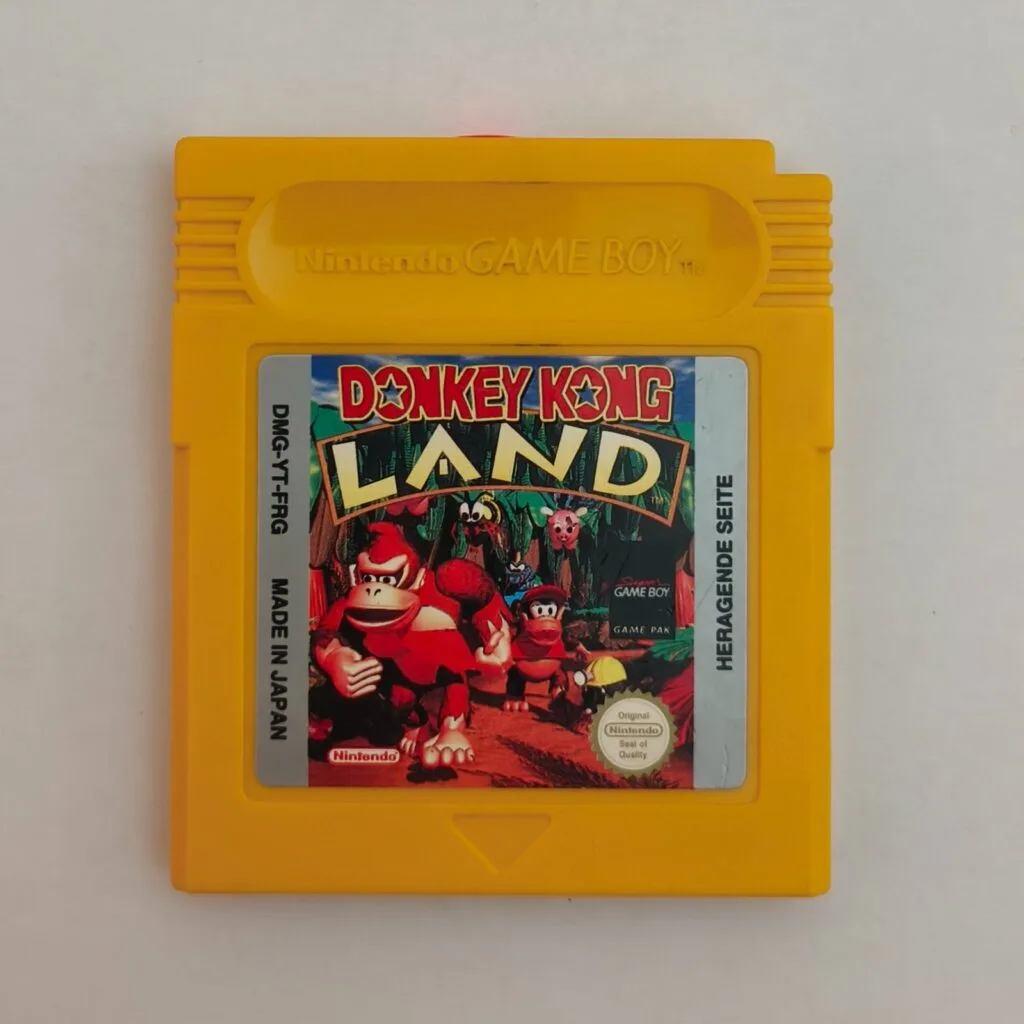
This is the one almost nobody knows about and the one that annoys people most. Games for the Game Boy, Super Nintendo or Nintendo 64 store your progress on a small button cell inside the cartridge. Those batteries last roughly twenty to twenty-five years. For a lot of classics that time is simply up.
The game then still runs perfectly, you can play it through, but when you switch off it is all gone. This is fixable, the battery can be replaced, and we do that here ourselves. But you want to know whether it is needed before you buy, not after.
Third, the region
Older consoles are region locked. An American Super Nintendo cartridge does not fit a European console, and a Japanese PlayStation 1 disc will not start on a Swiss machine. That is not a fault, it was the manufacturer’s intention back then.
In Europe there is also the fact that very old titles sometimes run slower in PAL than the original. For most people that makes no difference. But if you are specifically after a certain experience, it is worth knowing which version you have in front of you.
Fourth, a scratch is not just a scratch
On a disc the direction decides. Fine circles that follow the movement of the disc are usually harmless, that is normal wear from the drive. A scratch that runs across, from the inside out, is the problem, because it overwhelms the error correction in one place.
On cartridges it is the contact strip that counts instead. If the gold stripes are evenly bright, all is well. If they are stained, greenish or dull, the cartridge has had damp. That can be cleaned, but it also tells you something about where it was stored.
Fifth, the cover art is not just decoration
On games in cardboard boxes, so on almost everything before the DVD era, the cover is the expensive part. A complete cartridge with box and manual can be worth a multiple of what the loose cartridge costs. So if you are weighing up whether to take the slightly dearer complete version, that is not only a question of looks. It is the version that holds its value.
Sixth, who answers for it when something does not work
This is the real difference between buying from a listing and buying in a shop. In a private sale there is as a rule no warranty at all. If the game turns up faulty, the argument is yours to have.
We check every item ourselves before it reaches the shelf, and we give twelve months of warranty and thirty days of return rights on everything we sell. The details are on Warranty. That is not a marketing line, it is the reason we handle every device and every game before we offer it.
Seventh, buy the game, not the nostalgia
The most common bad buy is not a technical one. It is the title you loved at fourteen, play for three evenings and then never look at again. That is no tragedy, it only costs money and shelf space.
A good test is to ask yourself whether you want to play the game or whether you want to own it. Both are fair, but they are two different purchases. If it is about owning, take the complete version, that is the one that holds its value. If it is about playing, the loose cartridge does the job just as well and you save a good deal.
And if you still have some yourself
Most people who buy used games have a box of their own at home. If you want to know what your old titles and consoles are still worth today, you describe them in a few clicks on Sell, no photos needed. You see your price straight away, with no waiting. Shipping is free for you, and you decide only once you have seen the number. What is in the shop today arrived exactly like that.